Loading...
Serving Westerville, OH and surrounding areas. (380) 259-5083
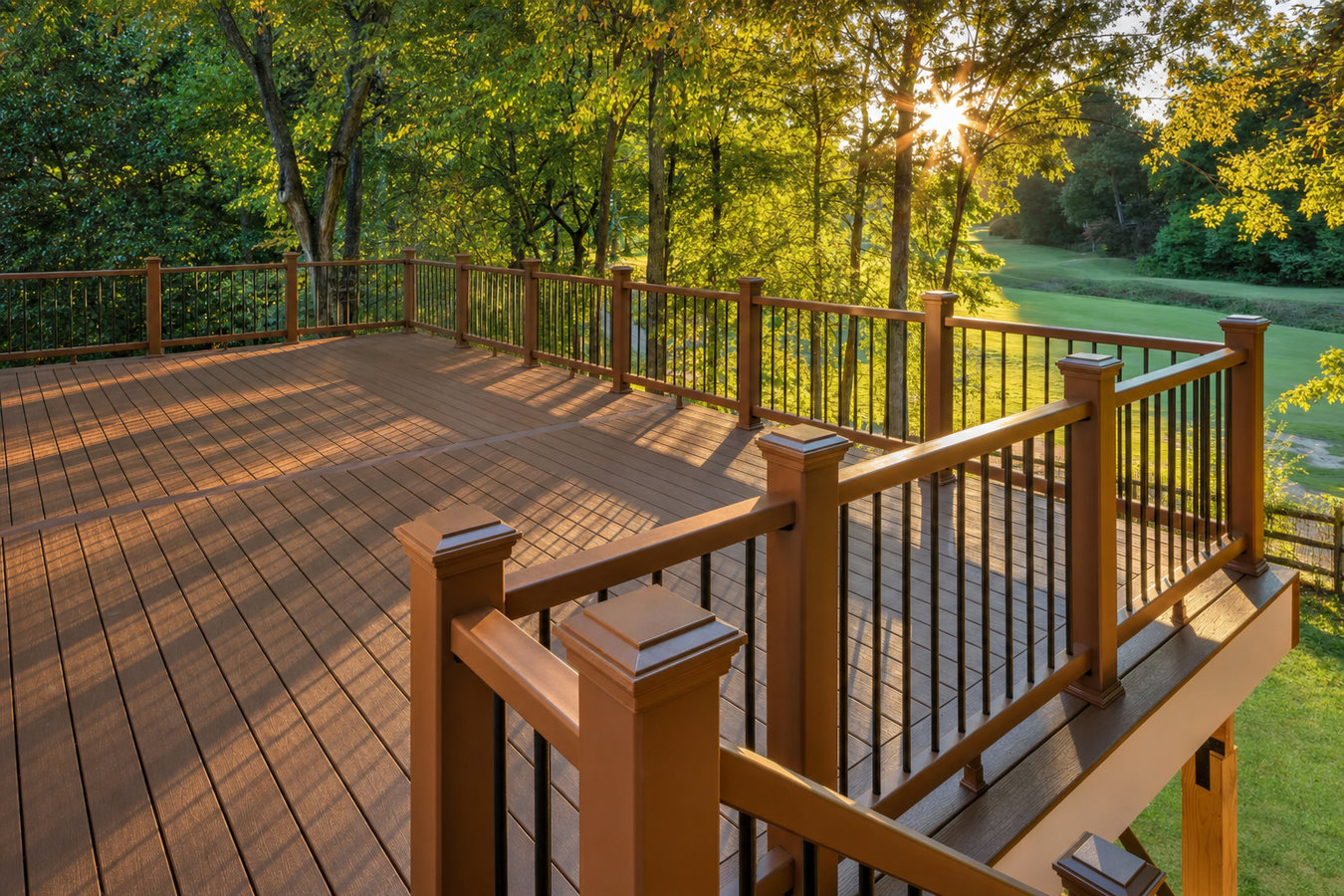
A railing that wobbles or does not meet current safety standards is a liability for your family and a problem when you sell. We install deck railings in Westerville that are properly anchored, correctly spaced, and documented with a city inspection.
Installing deck railings in Westerville, OH involves anchoring posts to the deck frame, installing the top and bottom rails, and spacing the balusters to meet Ohio safety requirements - most jobs take one full day of installation after permit approval, with the full timeline from contract to final inspection running two to four weeks.
Ohio requires a railing on any deck surface that is 30 inches or more above the ground. That requirement exists for a reason: an elevated deck without a properly anchored railing is a fall hazard. Beyond height, the gaps between balusters have to be small enough that a small child cannot get through or get their head stuck. These are not arbitrary rules - they are the minimum standard that every railing we install meets or exceeds. For homeowners building a new deck or replacing one, deck railing installation pairs directly with a multi-level deck project, where every level change requires a railing that meets current code.
The post is the most structurally important part of the whole railing system. If it is not anchored solidly to the deck frame - not just surface-mounted with a lag bolt into the decking boards - the railing will wobble under pressure even if it looks fine from a distance. Give the top rail a firm sideways push after any railing installation. If it moves at all, the posts need attention before the job is signed off.
Stand at the top rail and give it a firm push sideways. If it moves at all - even slightly - the posts are no longer anchored the way they should be. This is the clearest sign your railing has become a safety issue, not just a cosmetic one. It will not fix itself, and the problem typically gets worse through seasonal movement.
A large number of Westerville homes from that era have original railings that are now 30 to 40 years old. Wood from that period has gone through hundreds of freeze-thaw cycles, and the fasteners holding everything together may be corroded or loose even if the railing looks passable from a distance. Older railings were also built to standards that do not match what Ohio requires today.
Run your hand along the top rail and the posts. Soft spots, flaking wood, or cracks that go deep into the grain mean the wood has broken down from the inside. Painting over this will not fix it - once rot sets in, replacement is the only lasting solution. Ohio's wet springs and temperature swings accelerate this process on wood railings that have not been regularly sealed.
Ohio's current safety requirements call for baluster spacing narrow enough that a 4-inch sphere cannot pass through. If you can fit your fist through the gap, your railing does not meet today's standards. This matters most if you have young children or grandchildren visiting - and it is a flag that home inspectors in the Columbus area routinely note during buyer inspections.
We install deck railings in wood, composite, and aluminum, and we match the material to the deck, the climate, and the homeowner's maintenance preferences. Every installation includes posts anchored to the deck's structural frame - not just surface-mounted - and baluster spacing verified to meet Ohio's current requirements. We pull the permit, schedule the city inspection, and give you the documentation when the job is done. For new deck projects, railing work is coordinated alongside the custom deck design and build process so the railing system is designed from the start as part of the whole structure rather than added afterward.
If your neighborhood has an HOA, we check what materials and styles are permitted before ordering anything. Some HOAs in Westerville have specific requirements about railing colors or profiles, and finding out after the materials are on-site creates delays. We also handle railing work as part of larger deck replacement projects - if the frame and decking are sound but the railing has failed, a railing replacement is often the most cost-effective way to bring the whole deck up to current standards without a full rebuild. For homeowners looking at a multi-level deck project, railings are a required component at every level change and are planned and priced as part of the whole build.
Best for homeowners who want a traditional look at the lowest upfront cost, with a commitment to sealing every two to three years to maintain durability.
Best for homeowners who want a wood-like appearance with minimal ongoing maintenance - no painting, no sealing, and resistance to Ohio's moisture and temperature swings.
Best for homeowners who want a clean, modern profile that will not rust, rot, or need painting regardless of the weather.
Best for homeowners who want unobstructed sightlines from the deck - typically paired with composite or multi-level builds where the view is a key part of the design.
Central Ohio's repeated freeze-thaw cycles through winter are hard on railing posts. The ground expands and contracts, and posts that were not anchored with enough bite into the structural frame will start to shift. A railing that felt solid in October can be noticeably loose by March if the installation did not account for seasonal movement. This is especially common on older decks where the original post connections have corroded over 30 or 40 winters. Much of Westerville was built during the suburban growth of the 1980s and 1990s, and homes from that era frequently have railings that are now beyond their useful life. Homeowners near Westerville and the surrounding neighborhoods are more likely than not to be dealing with original railings that no longer meet current safety standards.
The City of Westerville also has its own active Building Division, separate from Franklin County, that handles residential permits and inspections. Railing replacement on an elevated deck typically requires a permit here, and a contractor who skips that step saves themselves paperwork at your expense - you end up with documentation gaps that can surface during a home sale or an insurance claim. We also work regularly in Columbus and the broader metro area, and the permit and HOA landscape in Westerville is one we navigate on a regular basis. If your neighborhood has HOA rules about railing styles, we confirm what is allowed before any materials are ordered.
Tell us what you are working with - replacing an old railing, adding one to an existing deck, or upgrading material. We respond within one business day and schedule a time to see the deck in person before giving you a price.
We visit your deck, take measurements, and look at the current framing condition. We discuss material options with you and note anything about the existing structure that needs to be addressed first. The written quote breaks out labor and materials separately.
We handle the permit application with the City of Westerville's Building Division before any work begins. If your neighborhood has an HOA, we confirm material and style approvals. This stage typically adds a few days to a couple of weeks, and a reputable contractor handles it without putting that burden on you.
Most standard railing jobs are complete in one day. After installation, the city sends an inspector to verify the work. When everything passes, we walk the railing with you - push test the posts, check spacing, review any maintenance the material requires - and hand over the final documentation.
Free written estimate, permit handled for you, city inspection included. Most installations are complete in one day.
(380) 259-5083We anchor every post to the deck's structural frame - not just the surface boards - so the connection holds through repeated freeze-thaw cycles. A railing that passes a push test on installation day should still pass that test after three Ohio winters.
We pull the building permit from the City of Westerville's Building Division, coordinate the inspection, and hand you the final card when the job is closed out. That documentation protects you now and when you sell your home - an uninspected railing replacement is a gap a buyer's inspector can flag.
Westerville's planned communities often have railing style and color rules, and we check what is allowed before anything is ordered. Homeowners in HOA-governed neighborhoods do not have to figure out their association's review process on their own - we have navigated it enough times to know how to move through it efficiently.
Ohio requires railings at 36 inches tall on elevated decks, with baluster spacing tight enough to block a 4-inch sphere. The Consumer Product Safety Commission notes that railing failures are among the most preventable deck hazards - see guidance at cpsc.gov. We confirm both height and spacing on every installation before the city inspection.
Solid post anchoring, pulled permits, HOA coordination, and verified safety dimensions are the difference between a railing that just looks right and one that holds up under actual use and survives scrutiny at resale. The North American Deck and Railing Association and the Consumer Product Safety Commission both publish standards for what a properly installed railing should look and feel like - we build to those standards on every job.
When you are starting from scratch, railing design is part of the overall deck plan - not an afterthought added at the end of a separate project.
Learn MoreMulti-level decks require railings at every elevation change - we design and install the railing system as part of the whole build.
Learn MoreDeck contractors in Westerville fill their spring schedules fast - reach out now for a written estimate and a confirmed spot on the calendar before summer entertaining season.